Level 4 Drywall
Walls Finished Smooth and Ready to Paint
Level 4 Drywall in Oakley for standard residential walls that need a clean, painted finish without visible seams or fastener marks
Baltodano's Drywall completes Level 4 finishes for homeowners and property managers across Oakley who need walls that are properly prepared for paint without paying for finish levels the space doesn't require. This finish is the right choice for bedrooms, living rooms, hallways, and offices—spaces where the lighting is diffuse and the final coat will be flat, matte, or low-sheen paint. The result is a wall surface where joints, corners, and fasteners are no longer visible once paint is applied.
Level 4 finishing involves taping all joints and interior corners, applying joint compound over fasteners, and then sanding the surface until it's uniformly smooth. Three coats of compound are typically applied—a tape coat, a filler coat, and a finish coat—with each layer requiring sufficient drying time before the next is applied. The decision to stop at Level 4 rather than proceeding to Level 5 is driven by the paint sheen and lighting conditions in the room: flat and matte paints are forgiving enough that the additional skim coat used in Level 5 isn't necessary and won't change what you see on the finished wall.
Request a walk-through estimate based on the specific rooms and wall conditions at your property.
What Level 4 Finishing Actually Accomplishes
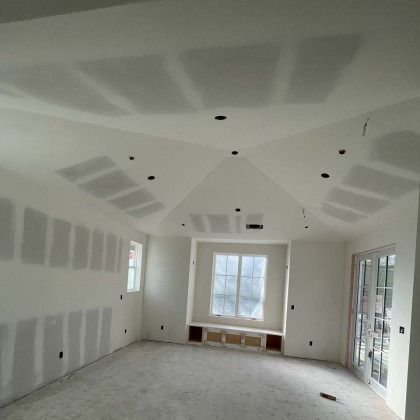
Once the joint compound is fully cured and the surface is sanded, you'll have walls that show no ridges at seams, no dimples at screw heads, and no visible corner bead edges. The surface is primed and ready for paint without additional prep work. Because the entire wall isn't skim-coated, the texture of the drywall face paper remains present—which is why this finish level depends on using the right paint sheen to avoid telegraphing that texture under strong light.
After Baltodano's Drywall completes a Level 4 finish, the most immediate change you'll notice is that the wall reads as a continuous, even plane rather than a series of panels. Screw patterns disappear, tape lines stop being visible, and corners sit flush. In standard interior lighting conditions with a flat or matte paint applied, the surface will hold up to close inspection without revealing the underlying drywall construction.
It's worth noting that Level 4 is not appropriate for every application. Walls that will receive semi-gloss or high-gloss paint, spaces with large windows generating strong raking light, or feature walls under focused artificial lighting are situations where the additional labor of Level 5 finishing is justified. For the majority of standard interior walls in residential builds and commercial office spaces, Level 4 delivers a result that meets the functional and visual requirements without the additional cost of a full skim coat.
Common Questions About This Service
Homeowners in Oakley and surrounding communities often want to understand exactly what they're getting before committing to a finish level, particularly when they're working with contractors or designers who may use these terms differently.
- What does Level 4 drywall finishing actually include?
- Level 4 includes paper or mesh tape embedded over all joints, three coats of joint compound applied to joints and fasteners, and a final sanding pass that leaves the surface smooth and paint-ready—it does not include a full skim coat over the entire panel face.
- How do I know if Level 4 is the right finish for my project?
- The deciding factors are paint sheen and lighting: if your walls will be painted with flat or matte paint and aren't positioned to catch strong natural or directional artificial light, Level 4 is the appropriate standard for that space.
- Why does the choice of paint sheen affect which finish level I need?
- Semi-gloss and satin paints reflect light at angles that make surface texture and minor imperfections more visible, which means a wall finished only to Level 4 may show subtle paper texture or faint joint lines once that paint is applied.
- What causes drywall joints to show through paint after a room is finished?
- Insufficient compound coats, inadequate drying time between coats, or skipping the final sanding pass are the most common causes—each one leaves a ridge or depression that paint follows rather than conceals.
- When is the right time to schedule finishing work in an Oakley home? Drywall finishing should happen after all rough mechanical, electrical, and plumbing work is inspected and closed—high humidity from construction activity or incomplete building envelope work can extend compound drying times and affect how the finish sands.
Baltodano's Drywall can review your project plans and confirm whether Level 4 meets the requirements for each space—arrange a consultation to go over wall locations, lighting conditions, and your planned paint selections before work begins.