Level 5 Drywall
The Finish That Holds Up Under Scrutiny
Level 5 Drywall in Livermore for high-end walls and ceilings where dark paint, glossy finishes, or strong lighting would expose surface imperfections
Dark paint colors and satin or semi-gloss sheens are unforgiving—they reflect light at angles that make joint lines, screw dimples, and panel texture visible even after a standard finish has been applied. Baltodano's Drywall performs Level 5 finishing for Livermore homeowners, builders, and commercial clients who are using paint selections or lighting conditions that would expose the limitations of a lower finish standard. This is the highest recognized finishing level and the one specified when the final appearance of the wall cannot tolerate any surface variation.
Level 5 includes everything completed in Level 4—taped joints, filled fasteners, and sanded coats of joint compound—plus one additional step: a thin skim coat of joint compound applied across the entire panel surface. That skim coat fills the texture of the drywall face paper itself, creating a wall that is uniformly smooth at a microscopic level rather than just smooth at the seams. This matters because when a semi-gloss or dark paint is applied over an unskim-coated wall, the difference in porosity between the face paper and the compound-covered joints causes those areas to absorb paint differently—producing a shadowed effect called photographing or joint shadowing that no amount of additional paint coats will fully eliminate.
Set up a detailed project review to confirm which walls and ceilings in your space qualify for Level 5 and what the scope of work involves..
Why the Skim Coat Changes the Outcome
The skim coat applied across the full panel surface in Level 5 finishing is typically 1/16 to 1/8 of an inch thick—thin enough that it adds minimal build to the wall but sufficient to seal the drywall paper uniformly. Once this coat is sanded and the surface is primed with a PVA or drywall-specific primer, the wall absorbs paint consistently across its entire face. That uniform absorption is what prevents joint shadowing under raking light or reflective paint finishes.
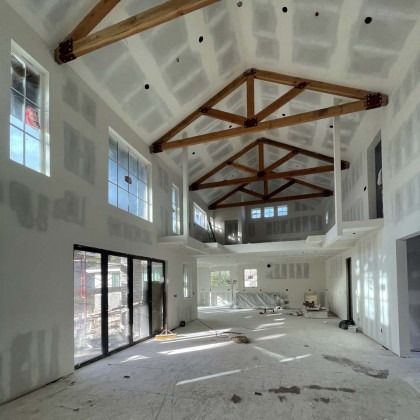
After Baltodano's Drywall completes a Level 5 finish, the visual change is most obvious in spaces with large windows or directed lighting: shadows and irregularities that would have appeared along joint lines simply aren't there. Feature walls with bold or dark paint colors read as solid, flat planes rather than revealing the grid of underlying panels. Ceilings, which are particularly prone to showing imperfections under overhead lighting, appear uniform rather than patchy.
Level 5 finishing costs more than Level 4 because the skim coat requires additional labor time and material, and it must be sanded carefully to avoid cutting through to the tape layer below. Not every wall in a project needs this level—it's typically specified for ceilings, feature walls, rooms receiving dark or reflective paint, and commercial spaces where lighting design emphasizes wall surfaces. Understanding which areas justify the investment is part of the planning conversation before work begins..
What Clients Ask Before Choosing Level 5
Clients in Livermore who are specifying paint colors, planning lighting layouts, or working with interior designers frequently have specific questions about when Level 5 is necessary versus when it adds cost without changing the visible result.
- What is the difference between Level 4 and Level 5 drywall finishing?
- Level 4 covers joints and fasteners with compound and sands them smooth, while Level 5 adds a full skim coat over the entire panel surface—that additional layer is what prevents surface variation from appearing under reflective paint or strong lighting.
- How do I know if my paint color requires Level 5?
- Colors in the medium-to-dark range—particularly blues, grays, greens, and blacks—reflect light at angles that reveal surface texture and joint lines, making Level 5 the appropriate specification for walls receiving those colors in satin or higher sheen.
- Why do ceilings often need Level 5 even with white paint?
- Overhead lighting, whether natural from skylights or artificial from recessed fixtures, creates raking light across the ceiling plane that makes even minor surface variation visible—white paint doesn't prevent this because the light angle, not the color, is what reveals imperfections.
- What happens if Level 4 is applied where Level 5 is needed?
- Joint shadowing becomes visible after paint is applied, particularly in angled or strong light, and the issue cannot be corrected by adding more paint—the wall typically has to be skim-coated and refinished after the fact, making it more costly than specifying correctly upfront.
- Does the dry climate in Livermore affect how joint compound cures during finishing?
- Lower humidity can accelerate surface drying while compound deeper in the coat is still wet, which leads to cracking if additional coats or sanding happen too soon—proper staging of coats is critical in the Bay Area's dry summer conditions.
Baltodano's Drywall can evaluate your paint specifications and lighting plan to confirm which surfaces require Level 5 and provide an accurate scope—contact the office directly to schedule that assessment before your project moves into the finishing phase.